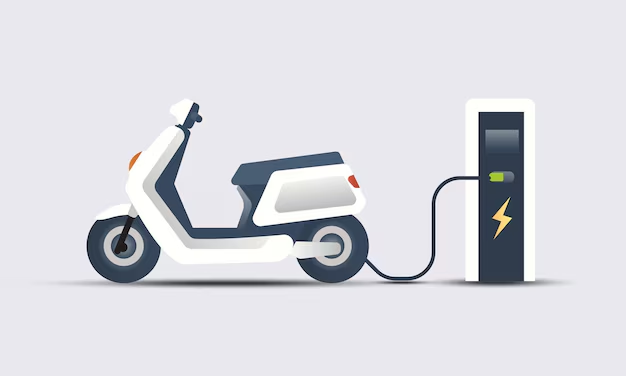
India stands at an inflection point in its transportation history. After decades of near-total dependence on internal combustion engines, the country is witnessing an electric mobility revolution that is no longer confined to policy papers and industry conferences. In 2025, India sold over 1.5 million electric two-wheelers and nearly 120,000 electric cars — numbers that would have been dismissed as fantasy just five years ago. As we move through 2026, every indicator suggests that this trajectory is not only sustainable but accelerating, and the implications for businesses, consumers, and communities across the country are profound.
The central government's commitment to electrification has been the single most important catalyst for this shift. The FAME III scheme, launched in October 2025 with an outlay of INR 10,000 crore, offers more generous subsidies than its predecessors while also extending coverage to electric three-wheelers and light commercial vehicles. State-level incentives have amplified the impact: West Bengal, Maharashtra, Delhi, and Karnataka now offer road tax exemptions, registration fee waivers, and additional purchase subsidies that can reduce the effective cost of an electric two-wheeler by INR 30,000-40,000. For a price-sensitive market like India, where the average monthly household income in tier-2 and tier-3 cities hovers around INR 30,000-50,000, these incentives are not merely helpful — they are decisive.
Charging infrastructure, long cited as the Achilles' heel of EV adoption, is finally receiving the investment it needs. The Bureau of Energy Efficiency (BEE) reports that India now has over 12,000 public charging stations, up from approximately 2,700 in 2022. Private players like Tata Power, Ather Grid, Charge Zone, and BPCL's partnership with Sun Mobility are aggressively expanding networks along national highways and within city centres. At Biplab Group, we have taken this mission to the semi-urban level through Bankura EV Care, which recently inaugurated a 6-bay DC fast-charging hub on NH-14 — the first public fast-charging facility in Bankura district. Our conviction is simple: EV adoption will stall unless charging is as convenient in Bankura as it is in Bengaluru.
The real story of 2026, however, is not happening in metros — it is unfolding in India's tier-2 and tier-3 cities. Towns like Bankura, Siliguri, Jhansi, and Hubli are seeing EV adoption rates grow at 40-60% year-on-year, out-pacing many metropolitan markets. The reasons are structural: shorter average commute distances (10-25 km per day), lower electricity costs compared to petrol, the availability of home charging (since most residents have dedicated parking), and a growing awareness of total cost of ownership rather than just sticker price. At Bankura EV Care, we have observed that nearly 70% of our electric scooter buyers are first-time EV owners who previously rode petrol-powered motorcycles or scooters — this is not an upgrade market, it is a conversion market.
Biplab Group's role in this transition extends beyond retail. Through Bankura EV Care, we are building an end-to-end EV ecosystem that includes sales, service, charging infrastructure, battery diagnostics, and customer education. We stock and service vehicles from Ola Electric, Ather Energy, and TVS — three brands that collectively represent over 75% of India's electric two-wheeler market. Our service centre is equipped with OEM-certified diagnostic tools and trained technicians who understand the unique requirements of lithium-ion battery systems. We also conduct monthly awareness camps in surrounding villages and towns to demystify EV technology, explain subsidy application processes, and offer test rides to prospective buyers who may have never sat on an electric vehicle before.
Looking ahead, I believe 2026 will be remembered as the year India's EV transition became irreversible. Battery costs continue to fall — lithium-ion cell prices dropped below USD 100 per kWh globally in late 2025, making electric vehicles increasingly competitive with their ICE counterparts even without subsidies. New entrants like Bajaj, Hero Electric, and Ultraviolette are intensifying competition, which will drive both innovation and affordability. At Biplab Group, we are planning to expand our EV operations to Purulia and Bishnupur by early 2027, with solar-assisted charging stations and mobile service vans that can reach customers in remote areas. The vision is clear: Bankura should not be a footnote in India's EV story — it should be a model for how semi-urban towns can lead the charge toward a cleaner, more sustainable future.